Home
| About | News | Books | Works | Appearances | Contact
Reviews
of Crossing Borders: Personal Essays
Troncoso, Sergio, Crossing
Borders: Personal Essays, Arte Publico Press,
September 2011, ISBN-10: 1-5588-5710-9, ISBN-13: 978-1558857100
(paper), $16.95; also available on Kindle and Nook.
·
Best
Books of 2011 by The Hispanic Reader
·
Bronze
Award for Essays in ForeWord Review’s Book of the Year Awards
·
Second
Place for Best Biography in English in the International Latino Book Awards
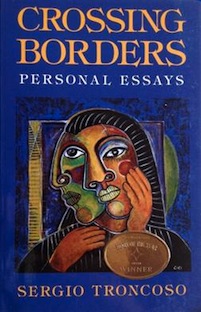 Sergio Troncoso's Crossing Borders: Personal Essays
is an engrossing and revealing peek behind the curtain of one writer's creative
process, development and struggles.
Sergio Troncoso's Crossing Borders: Personal Essays
is an engrossing and revealing peek behind the curtain of one writer's creative
process, development and struggles.
The reader is treated to crisp and evocative prose that wades into the
murky waters of ethnic, religious and familial identities….
In three heartbreaking interconnected essays, "Letter to my Young
Sons (Parts One, Two and Three)," he begins: "Two weeks ago, Aaron
and Isaac, I learned your mother Laura has breast cancer." We are plunged
into the world of surgical options, chemotherapy and physical therapy. Troncoso
skillfully and in exquisite detail allows us the privilege of entering into his
world as the disease affects not only his wife but also all who love her.
The fact that Troncoso's beloved wife is
Jewish imbues many of these essays with a sense of wonder and appreciation of a
religion and culture vastly different from the Mexican Catholicism of his
youth. In "Fresh Challah," we learn of his
newfound love for the traditional Jewish bread, which he can find in his
favorite
Troncoso has already made his mark in the literary world. But if Crossing
Borders is any guide, he will continue to spin stories and explain the
writer's life for many years to come.
---Daniel Olivas
for The
Troncoso’s literary text
begins with an emphasis on his own experiences, but his focus is much broader
and profound. Taken in by his clear yet captivating prose, the reader is pulled
into a text of philosophical reflections that focus on religious and ethnic
identities as well as what he has learned from various members of his family….
Ultimately, Troncoso’s writing is the voice of someone intent on
touching the souls of others, and in ‘Chico Lingo Days’ he speaks out: “So I
seek my audience with a vague hope to be heard.” Indeed, this author’s desire
is “at once to sanctify and upend life, to lift it from what it is, to focus
thought into words and create a call to what was and what is when we live.”
---Donna M. Kabalen
de Bichara for Camino
Real from Instituto Franklin
In this collection
of sixteen essays, Sergio Troncoso writes about family, fatherhood, education,
illness, love, politics, religion, social issues, societal responsibility, and
writing. He observes that his clear, direct writing about difficult questions
"has sometimes condemned [him] in academic circles" and that his
writing is also "overlooked by those who never desire to think beyond the
obvious and the popular." Troncoso chronicles his transformation from
"a besieged outsider needing a voice" to "an outsider by choice
deploying [his] voice," creating an intellectual borderland from where he
tried to push his mind with the philosophical ideas that form the framework of
his writing.
In the first and
title essay, Troncoso examines the many types of borders—geographical,
linguistic, cultural, and religious—he has crossed since leaving his childhood
home in
Three of the
essays in this collection are letters to his two young sons, documenting their
mother's battle with breast cancer. He celebrates their life together while simultaneously
contemplating a possible future without his wife. The letters offer an intimate
portrait of a family in crisis and reveal the wife's ordeal and the writer's
anguish. They also depict the complexities of a large hospital and provide a
personal look into our nation's health care system.
In many of the
essays, Troncoso focuses on Latinos living in the
In one passage,
Troncoso regrets being unable to introduce his children to Juarez—where his
parents were born and where, when Troncoso was a child, the family went each
Sunday to visit relatives—due to the drug and gun violence that render the city
unsafe. He directly blames the "voracious drug habits of the
Troncoso
discusses the multidimensional plight of illegal immigrants in "Chico
Lingo Days." He denounces the phrase "illegal is illegal" as a
stupid tautology that "glosses over the complex context of undocumented
workers in the
Recently,
President Obama announced some major changes in
---Cheryl Wright-Watkins for NewPages.com
The essays of Crossing Borders range from the
personal and family history to the politics of Latino literature to the
terrorism of fundamentalists and drug cartels. For example, “Literature and
Migration” establishes Troncoso’s desire to write
“philosophical stories questioning the basis of morality” while at the same
time setting out “to write so my father and mother could understand me.” Meanwhile, in “Apostate of my Literary
Family,” he writes about his frustration in championing Latino literature as a
board member for a non-profit literary organization with literary elitist
tendencies. The three-part “Letter to My Young Sons” is a heartbreaking and
life-affirming account of his wife’s diagnosis of breast cancer and their
struggle to combat it. Troncoso is
adroit in handling the complex language and science of oncology in “Letter to
My Young Sons”– he writes with the precision of a journalist, while still
giving it a heartbeat. “The Father is in
the Details” is a charming essay about the quotidian life of a writer and
father; whereas the essay, “This Wicked Patch of Dust,” brings us the gloomier
side of fatherhood in which Troncoso, now playing the role of the son,
describes a trivial quarrel with his father that results into a years-long
rift. He handles this essay like a
literary piece, giving way to dialogue, story arc, and characterization. Also
included in this collection are posts from Troncoso’s
blog, “Chico Lingo,” which range from how to negotiate Christmas traditions
with Jewish life to the border violence brought on by the drug cartels.
Troncoso’s essays are
lucid, philosophical, and erudite without being condescending to the
reader. Crossing Borders signals
a shift in writing about what it means to be Chicano and a writer in the early
21st century.
---John Olivares Espinoza for The Packinghouse Review
We live in a
complex time. Troncoso is a complicated man trying to understand a complicated
world. In his quest for understanding, he eloquently shares lessons learned in
16 provocative essays.
These very
personal essays cross several borders: cultural, historical and self-imposed.
For example, he
contemplates writer's block in "A Day Without Ideas," comparing it to
a deathlike existence where nothing matters and he will ‘simply be there.’
In a painful
letter to his sons detailing their mother's struggle with breast cancer,
Troncoso the writer reveals his true identity as Troncoso the frightened,
caring, and strong father.
He takes on the
9/11 attackers, in a piece called "Terror and Humanity," not with
hatred or revenge but with a plea for basic humanity. “To be human is to engage
with, to care about. To be human is to love another. To be human is to
communicate with someone, even if you are only shouting at them. The most human
of all is discourse. With nature. With other human beings.”
In "Fresh Challah," he writes, with some anxiety and plenty of
honesty, about major contradictions he has embraced--he is a Chicano from
Troncoso also
embraces his Latino identity and what it means to claim that identity. He
enlightens about racial politics, bicultural anomie and the “irrational fears
of non-Latinos to the growing Latino community.” However, his most moving words
are about his beloved and feared abuelita, the grandmother
who, even “if her dark brown eyes were downcast and weary she was poised for a
fight.”
Here is Troncoso
on his tough-love relationship with his grandmother: “I wanted to ensure she
did not have a hard life anymore; I wanted her to enjoy an elusive peace in her
soul. Most of all, I wanted her steely optimism never to be crushed by evil.
She had always been tough, and she also knew how to hurt her toughest
grandchild, the one with such a sharp tongue. So we understood each other only
too well.”
Although many of
the essays were written years ago, the collection remains timely. We owe it to
ourselves to read, savor and read them again.
---Manuel Ramos for The
“Sergio Troncoso takes us on
his journey from
---Kathleen Alcalá, author
of The Desert Remembers My Name
Though clearly set in turn-of-the-21st
Century Manhattan, there is a timelessness to the story. The reader can imagine
two boys, once grown, and again, when they too have young children, and then
again, decades later when their parents are elderly or perhaps no longer
living, reading and rereading, mining ever richer veins of meaning in these
heartfelt letters from their father.
---C. M. Mayo for Literal Magazine: Latin American
Voices
More a collection of chronological essays
than straightforward memoir, novelist Troncoso (The Last Tortilla and Other
Stories) depicts those important events and influences in his life that
took him from the dusty streets of the Ysleta barrio in 1960s
The “borders” of the title are many: intellectual, emotional, political and
religious; he describes his travels across each with wit and style.
Particularly gripping are three “letters” written to his young sons during
their mother’s successful battle with breast cancer while still in her 30s.
While stretched between two very distinct cultures (southwestern Mexican-American
and northeastern Jewish), Troncoso remains a strong advocate for a more
prominent Latino voice in the American literary world.
---Peter Fekety for REFORMA, the National Association to
promote Library and Information Services to Latinos
Crossing Borders is a series of personal
essays by author Sergio Troncoso that bring you into his family and his
personal growth. Troncoso writes about crossing personal religious and cultural
borders, as well as literal borders, and brings the reader into experiences they
are not likely to have on their own. Crossing
Borders is a book the reader will get invested in, if only to
learn more about the family being talked about in the essays. Most heartwrenching are the three pieces entitled “Letter to My
Young Sons,” which details their mother’s battle with cancer and shows a
father’s love for his children. If a reader only reads one essay, though, it
should be “Why Should Latinos Write Their Own Stories,” a piece that shows the
importance of preserving heritage and teaching the world things that they may
not know about Latinos. In all, Troncoso’s book is a
piece of artwork and a piece of heritage that everyone, not just Latinos,
should take the time to read.
---Melissa Boles for
In his sixteen personal essays, Sergio
Troncoso explores many borders. He is somewhere in between, mestizo. Whether from the border
in
Throughout his essays, Troncoso establishes
a recurrent theme of the need to battle dominant power structures. As an
established writer in
This racism or paranoia of illegal
immigrants angers Troncoso. He writes about the times he stayed in a hotel for
a conference and reflects on conversations with the cleaning ladies.
Hauntingly, he recalls one woman, an illegal immigrant, Maria Teresa, who told
him she wanted her children to be just like him when they grew up- educated.
Another, Julia, longs to learn English but has no time because she works two
jobs.
Troncoso calls his readers to take
political action, hoping to expose the truth that
The writer appears powerless not when he
exposes racial tensions but when he recalls the battle that his Jewish wife
Laura fought against breast cancer. Here Troncoso describes how his life came
to a halt. He captures the pain he and his family suffered watching Laura
struggle to live. He also crosses another border when he finally attains his
Jewish-in-laws’ approval after having loved their daughter during her pain.
When Troncoso focuses on moments of
humanity and frailty, he is most successful, whether writing to create an
individual face for immigrants, refusing to let them be dehumanized, or giving
a face to cancer by sharing his wife’s story.
The book is not adorned with rich, poetic
language; Troncoso writes clearly, plainly, and purposefully. Readers may find
that the writer’s style does not always remain consistent from one essay to the
next, but the stories are entertaining; they cross borders and challenge the
definition of American identity.
---Danielle Dahmann for Southwestern American Literature
Sergio Troncoso was born in the shantytown
of Ysleta, in
When he was a child, he recalls, there was
no running water or electricity in the houses of this neighborhood a short
distance from the border with
Troncoso, however, had a childhood amply
enriched by books and by family histories that were all around him.
His life changed radically after he
obtained a scholarship to pursue a college education at Harvard, an
unimaginable achievement in such a humble community.
A large part of his literary work is born
from the challenges of this experience, in his essays that comprise Crossing
Borders: Personal Essays as well as his recently published novel.
In the 16 essays of Crossing Borders, the
distinct borders —linguistic, cultural and interpersonal— are explored that the
author needed to navigage throughout his career.
In an intimate manner, these reflections
reveal the challenges of being a writer, an intellectual Latino, and in
addition, a husband, father, son, and grandson.
The frankness with which Troncoso approaches
painful themes is surprising, as he does in the three-part letter to his sons
in which he relates his wife’s battle against breast cancer.
In the third part, for example, the author
describes how each bump the taxi crossed on their way from the hospital to
their home caused his wife intense pain.
Once at home, one of their sons rushes to
hug his mother, but the father has to intercept the boy with his own hug to
remind the child to be gentle with his mother.
With tears in his eyes, their older son
tells her of his day at school, while the baby slides next to his mother and
lays his head on her lap, holding her arm with his tiny fingers, almost without
moving “as if in a trance.”
It is these details that fill the simple
and accessible prose of these essays with life, demonstrating how from such
personal experiences emanate a universal message about what unifies us, despite
our many differences.
---Spanish
News Agency EFE
“Touching and intelligent,
this book shows what it’s like growing up an intellectual on the border of the
---Daniel Chacon, author of and the shadows took
him and Unending Rooms
“Without words I can’t return and easily
remember and appreciate my life behind me,” Mexican-American Sergio Troncoso
writes. “I can’t see the road I traveled and how much I changed. Without words,
I feel as I have never existed.”
In his two recently released books, Crossing Borders: Personal Essays
and the novel From This Wicked Patch
of Dust, Troncoso tries to bring more meaning to his life and the
world.
The title of Crossing Borders comes from the fact that Troncoso’s life bridges two cultures – as a former resident
of the border town of El Paso; as a husband in an interfaith marriage and as a
writer who belongs to an almost all-white literary group. In the 16 essays,
Troncoso tackles issues such as the drug wars, immigration, and literature. But
Troncoso is at his best when he gets personal.
In an unusually honest essay, he talks
about an intense argument with his father. He describes how much he loathes
some of his father’s characteristics, yet still loves him. He also discusses
his own role as a father to two boys. He can be temperamental toward them, too,
when he succumbs to the pressures of life. But he is a devoted work-at-home
father who admits his career takes second place to his children. “To make a
good home for my children, I have sacrificed the only thing that matters more
than my family: I have novels in my head which I may or may never get a chance
to write,” he says….
Troncoso is an elegant writer whose work
will make readers grateful that he writes his life down.
---The Hispanic Reader
"Border-crossings
is a metaphor for the experience of Hispanic-American professionals traversing
---Frank Alvarez, President and CEO of the Hispanic Scholarship Fund
“In this collection of essays,
Sergio Troncoso takes the reader on an intensely personal look at his
musings...the inner workings of his mind as he seeks his truth, his reality
through reflection. Sergio draws the reader into his exploration of the meaning
of truth through relationships: with his wife and cancer, his sons, his
parents, his grandmother, his culture, with his Ivy-League colleagues and much
more. These unadulterated reflections look at the emotions of fear, anger,
disappointment, love and self-realization. His self-questioning commentary and
analysis invite the reader into an intense and emotive dialog with her own
reality again and again...long past the initial reading. I loved the work.”
---Nora Comstock, President and CEO of Las Comadres para las
 Please feel free to use these discussion questions
for Crossing
Borders: Personal Essays for writing classes and workshops.
Please feel free to use these discussion questions
for Crossing
Borders: Personal Essays for writing classes and workshops.
Short stories: Angie Luna, The Snake, A Rock Trying to be a
Stone, and Espíritu Santo.
Essays: Imagine
Ysleta, A Day
Without Ideas, Fresh
Challah, and Why Should Latinos
Write Their Own Stories?